


AI Game Master - Dungeon RPG
Digital Dynasty Entertainment Inc
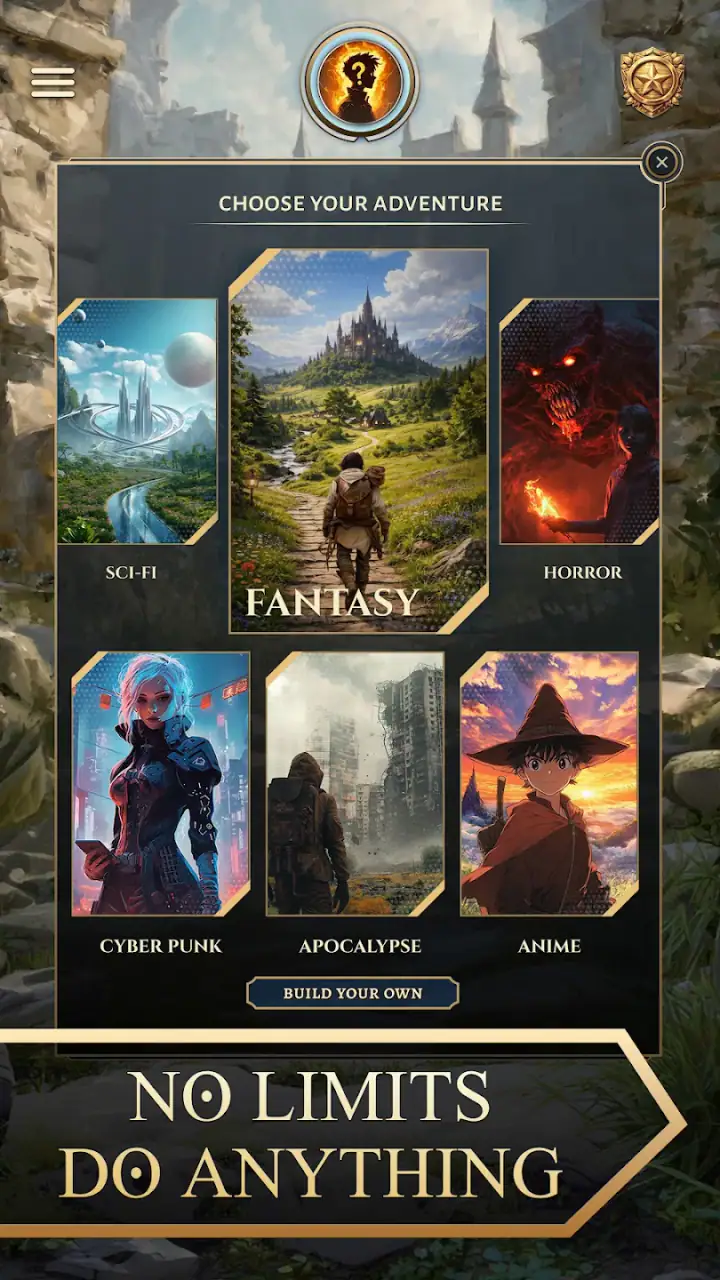
I approached AI Game Master - Dungeon RPG expecting a role-playing game built around conversation rather than a fixed sequence of battles. That is exactly where its appeal lies: instead of selecting from a long list of prewritten dialogue options, I can describe what my character wants to do and let the AI Game Master shape the next part of the adventure. It feels closer to improvising a tabletop fantasy session than following a traditional mobile campaign.
This is a free role-playing game from Digital Dynasty Entertainment Inc, aimed at players aged 10 and over. It has reached more than 100 thousand installs and holds a 4.6 average from roughly 15 thousand ratings, with around 2.8 thousand written reviews. Those figures suggest that the conversational format has found a real audience, but they do not change the central question: will I enjoy creating stories through text, or would I rather have a more visual, tightly designed RPG?
How the AI-led adventure actually feels
The most important thing to understand is that this is not simply a fantasy game with a chatbot attached. The AI Game Master is the main interface between me and the adventure. I write an intention, a question, or an action, and the game responds with a story development. That makes the experience flexible, but it also means the quality of a session depends partly on how clearly I communicate.
I get the best results when I treat each message as a useful piece of role-playing direction. “I attack” is easy for the game to process, but “I keep my shield raised, watch the doorway, and ask the wounded traveler who sent the bandits” gives the story more material to work with. This is one of the first practical lessons I would give a new player: describe motives, caution, and priorities, not only the final action.
The Dungeons & Dragons-inspired approach gives the fantasy setting a familiar shape without requiring me to sit down with a group, prepare a character sheet, or find someone willing to run a campaign. I can play as a solo adventurer and make decisions at my own pace. That makes it particularly convenient when I have a few quiet minutes and want an unfolding story rather than a quick arcade round.
Related News






At the same time, the game is not a substitute for a human Game Master in every situation. A person can remember the mood around a table, read the players’ reactions, and deliberately build toward a shared dramatic moment. An AI can respond quickly and creatively, but it may also take a scene in an unexpected direction or interpret a vague instruction differently from what I intended.
Why the text format is both the attraction and the challenge
The text-first design leaves room for imagination. I am not limited to the animations, maps, and character models supplied by a developer. A ruined chapel can feel eerie because of the description, and a suspicious merchant can become important because I decide to question him rather than walk away. The story is carried by language, so my own mental picture becomes part of the presentation.
That freedom also creates a higher reading burden than a conventional mobile RPG. Players who want constant visual feedback, fast combat, or a clear objective marker may find the experience slow. There is no avoiding the fact that I need to read, think, and type. For me, that makes it a good evening or travel companion, but not the game I would open when I want immediate action.
Gallery
A useful workflow is to establish a character’s personality early. I might decide that my adventurer is cautious, loyal to ordinary villagers, and unwilling to accept a suspicious reward. Keeping those traits consistent gives later choices more meaning. It also helps prevent the session from becoming a sequence of disconnected commands, because I am making decisions as one recognizable character rather than testing random prompts.
Making a session more coherent
I found that short planning notes are more valuable than trying to force the AI into a rigid script. Before entering a dangerous location, I can state my immediate goal, what information I already trust, and what would make me retreat. This gives the Game Master a clearer frame for the next response while still leaving room for surprise.
Another useful habit is to ask for consequences before committing to a risky action, without demanding a guaranteed result. For example, I can inspect the floor, listen at a door, or ask what my character notices before rushing forward. This creates a more deliberate rhythm and reduces the frustration of making a major decision based on an unclear scene description.
The trade-off is that I am doing some of the work a traditional game system normally handles automatically. In a conventional RPG, statistics, inventories, maps, and combat rules often provide a visible structure. Here, I need to pay attention to the narrative and keep track of important details myself. That is not necessarily a weakness, but it means the game rewards attentive players more than casual button pressers.
Cost, value, and the limits of free access
The game is free to download and play, which makes it easy to test without committing money first. That matters for this particular format because the appeal is personal: some players will immediately enjoy writing actions to an AI narrator, while others will know after a short session that they prefer a conventional RPG. Free access lowers the risk of finding out which group I belong to.
There are in-app purchases ranging from $0.99 to $209.99 per item. I would therefore approach spending carefully rather than assuming that every player will receive the same value from the free experience or that purchasing is necessary for everyone. The sensible starting point is to play enough to understand the story flow, response quality, and session length before considering any optional purchase.
Because the listed purchase range is broad, the right value judgment depends on personal use rather than on a single universal recommendation. Someone who treats the game as an occasional source of improvised fantasy may find free access sufficient. A player who spends a lot of time building long-running stories may view additional spending differently, but should still decide based on actual enjoyment rather than the promise of endless possibilities.
I also would not compare its price directly with a premium RPG and assume they offer the same kind of value. A paid, traditional game usually delivers a defined campaign, art, music, systems, and a controlled progression path. This title offers a different kind of value: the ability to shape scenes through conversation. If I want a polished visual world with predictable production quality, a premium alternative may be the better purchase even if it costs money upfront.
Where the game delivers more than a normal mobile RPG
The strongest value comes from personal agency. I can try an unusual solution that would never appear in a multiple-choice dialogue tree, such as negotiating with an enemy, distracting a guard, or investigating a seemingly minor clue. The result will not always be perfect, but the act of proposing the idea makes me feel more involved in the fiction.
It is also useful for players who enjoy experimenting with character concepts. I can play a cautious investigator one day, then approach another story as a reckless treasure hunter. That flexibility is more immediate than starting a new save in a large role-playing game, where changing identity often means replaying a substantial opening section.
A realistic everyday scenario shows the difference. If I have a short break after dinner, I can continue a conversation-based quest without needing to remember a complex control scheme or find a suitable stopping point in a real-time battle. I can make one meaningful decision, leave the story, and return later. The experience suits fragmented free time better than many action RPGs, provided I am in the mood to read and write.
Its value is weaker for someone who wants a social tabletop experience. Although the AI can provide a responsive narrator, it does not recreate the jokes, negotiation, and shared creativity of friends around a table. For that player, a multiplayer role-playing game or an actual online tabletop group may be more rewarding.
Friction I would want new players to expect
The first limitation is consistency. An AI-led story can be inventive, but inventive responses are not always the same as carefully managed continuity. I would keep important names, promises, clues, and goals in a small note outside the game. That simple habit helps me notice when a long session becomes difficult to follow and gives me a reference point when I return later.
The second limitation is input quality. The game cannot reliably infer every detail I have in mind. If I want my character to avoid killing an opponent, protect a companion, or conceal an item, I should say so directly. Clear instructions do not remove every surprise, but they make the interaction feel less random and give the narrative a better chance of following my priorities.
The third limitation is that text can make pacing uneven. A dramatic scene may move quickly, while an investigation can become a back-and-forth exchange that feels less focused. I can improve this by setting a local objective, such as finding the hidden entrance or learning who hired the mercenaries, instead of asking the story to remain open-ended for too long.
Players should also consider their tolerance for ambiguity. Traditional RPGs often show health, equipment, quest progress, and available actions in a way that makes the rules visible. Here, some of that understanding comes from the conversation itself. I enjoy that uncertainty when it supports role-playing, but I find it less satisfying when I am trying to determine exactly what the game expects from me.
Who will get the most from it?
I would recommend it most strongly to readers who already enjoy fantasy fiction, solo role-playing, interactive stories, or tabletop-inspired decision-making. It is especially appealing if the idea of writing “I search the old well before entering the tower” sounds more exciting than tapping a standard attack button. The game gives imagination a larger role than most mobile RPGs.
It can also work well for creative players who want a low-pressure way to test story ideas. I can explore how a character reacts to betrayal, negotiation, fear, or an impossible choice without preparing a full campaign. That makes the app useful not only as entertainment but also as a playful prompt for people who enjoy inventing settings and personalities.
I would be more cautious about recommending it to children who are not comfortable reading and typing independently, even though its content rating is Everyone 10+. The age label is helpful, but the actual enjoyment still depends on patience, comprehension, and the ability to express an action clearly. A younger player looking for colorful, instantly readable gameplay may prefer a more visual adventure.
It is not the right choice for players who want precise tactical combat, a strong competitive scene, or a fixed storyline with carefully staged revelations. It is also a poor match if I dislike AI-generated responses on principle or become frustrated when a story does not maintain perfect continuity. In those cases, a scripted role-playing game, a tactical RPG, or a human-led tabletop session would offer better control.
Device expectations and starting advice
The current version is 3.4.1, and the game supports devices running Android 7.0 or later. That makes it accessible across a wide range of Android phones and tablets, although the practical comfort of a text-heavy game will still depend on screen size and keyboard convenience. I prefer a larger display for longer sessions because it makes reading previous exchanges and composing detailed actions easier.
My advice for a first session is to begin with a simple character concept and a modest goal. Do not try to create an entire mythology, a complicated political history, and a dozen relationships in the opening messages. Start with one motivation, one useful skill, and one reason to accept the first quest. The story has more room to develop when the initial setup is clear rather than overloaded.
I would also save particularly good discoveries in a personal note. This is not busywork; it changes how I play. When I remember the name of a faction or the wording of an earlier warning, I can return to the story with a stronger sense of continuity and ask sharper questions. That turns the experience from random prompting into a lightweight campaign that I am actively helping to manage.
My verdict on paying, playing, or skipping
My overall view is positive, but specific. AI Game Master - Dungeon RPG is worth trying for free if you want a flexible fantasy story that responds to your own words. Its best moments come from making a decision that would not fit neatly into a conventional menu and seeing the adventure react. The combination of AI chat, fantasy role-play, and tabletop-inspired freedom gives it a clear identity.
I would not call it a universal replacement for a normal role-playing game. Its text-based presentation, dependence on clear prompts, and potential continuity friction are meaningful trade-offs. I would skip it if my priority is polished graphics, exact rules, fast combat, or a carefully authored campaign. Those needs are better served by a traditional RPG, even when that means paying upfront.
For everyone else, the free entry point makes experimentation reasonable. I would play first, judge how consistently the Game Master handles my choices, and only then consider an in-app purchase. The broad purchase range means I would keep spending tied to demonstrated enjoyment rather than treating payment as a requirement for the concept to work.
After spending time with it, I see this game less as a conventional mobile RPG and more as a portable storytelling partner. It rewards curiosity, clear writing, and a willingness to accept imperfect surprises. If that sounds like the kind of adventure I would enjoy sharing with a friend through conversation, I would recommend giving it a fair trial. If I want the game to do all the imagining, tracking, and directing for me, I would choose something more structured instead.
FAQs for AI Game Master - Dungeon RPG
What is AI Game Master - Dungeon RPG?
AI Game Master - Dungeon RPG is a role-playing adventure that uses artificial intelligence to create interactive dungeon stories, encounters, characters, and quests. Instead of following one fixed campaign, you can describe your actions in natural language and receive responses from the virtual game master. The experience is designed for players who enjoy improvisation, exploration, and tabletop-style storytelling on a mobile device.
How does the AI game master work during gameplay?
The game master interprets your decisions and generates narrative responses, combat situations, discoveries, and consequences based on the current adventure. You may be able to choose from suggested actions or type your own ideas, giving the campaign a more flexible feel than a traditional menu-based RPG. Because the content is generated dynamically, responses can occasionally be unexpected, inconsistent, or less polished than professionally scripted dialogue.
Does AI Game Master - Dungeon RPG require an internet connection?
An internet connection is generally important because the application needs to communicate with its AI systems to generate story content and respond to player actions. Offline functionality may be limited or unavailable, depending on the version and the developer’s current implementation. Before downloading, players should also consider mobile data usage, connection stability, and the possibility that server availability can affect how quickly the game responds.
Is AI Game Master - Dungeon RPG free to play?
The application may be available to download for free, but some features can depend on advertisements, in-app purchases, premium access, credits, or usage limits. These restrictions may apply to longer sessions, advanced AI models, additional adventures, or other optional content. It is worth checking the store listing carefully before starting, especially if you plan to play frequently or want uninterrupted access to the complete role-playing experience.
Is this game suitable for children and all types of players?
AI-generated role-playing content can vary according to the choices made during an adventure, and some scenarios may include fantasy violence, frightening themes, mature language, or unpredictable situations. The exact suitability depends on the game’s rating, content controls, and the way the AI responds to prompts. Parents should review the official age rating and privacy information, while new players should expect an experimental storytelling experience rather than a fully controlled children’s game.
Pros
- Creates dynamic quests tailored to your choices.
- Text-based gameplay works well on low-end devices.
- Supports creative problem-solving beyond fixed game paths.
- Quick to start
- with no complex rules to learn.
- Ideal for solo players seeking an improvised RPG experience.
Cons
- AI responses can occasionally feel repetitive or inconsistent.
- Story quality depends heavily on how clearly you write prompts.
- Limited visual content may not suit players seeking rich graphics.
- Some scenarios may lack the depth of a human-led campaign.
- Internet access may be required for core AI features.


